On this page
01Why this exists
Most people read a share count as one number. Outstanding went up, so the stock was diluted; it went down, so shares were bought back or retired. That number hides the part that moves the price in the short run. Every OTC share count is two buckets added together, and only one of them can be sold on the market today.
These posts print both buckets every time, including the one that did not move, so a reader can see in one glance whether a change added stock that can hit the bid this week or stock that cannot.
A smaller share count and a bigger tradable supply can happen in the same week. Outstanding and unrestricted can move in opposite directions, and when they do, the unrestricted line is the one the market feels first.
02When it posts
There is no fixed time. The account watches the share counts of every OTC name that has appeared on one of the daily boards in the last 120 days, checking several times a day. A change posts to X when it is material, which means at least 1% of shares outstanding or at least 5,000,000 shares, and when the reading behind it is no more than 45 days old. Every post is reviewed by hand before it goes out. Smaller changes are recorded but not posted.
03The four numbers
- Outstanding is every share that exists and is held by someone. It is the sum of the next two lines.
- Unrestricted is the part of outstanding that carries no restriction on resale. These shares can be sold on the open market once they sit in a brokerage account.
- Restricted is the part of outstanding that cannot be sold publicly yet. It still counts toward outstanding and still votes, but it cannot reach the bid until the restriction is lifted.
- Authorized is the ceiling the company's charter allows. It is not stock anyone holds. Raising it creates room for future issuance; cutting it takes that room away.
Each line is printed as before → after with the change in shares and in percent. A line that did not move is still printed and marked (unchanged), because the line that stayed still is half of the answer.
04Restricted and unrestricted
Where restricted shares come from. Shares a company issues without registering them with the SEC are restricted: stock sold in a private placement, stock paid to officers or consultants, stock issued to buy a business or a piece of land. The certificate or book entry at the transfer agent carries a legend saying the shares cannot be resold publicly until an exemption applies.
How they become tradable. The usual route is SEC Rule 144. In general terms, the holder waits out a holding period, six months if the company has been reporting to the SEC for at least 90 days and a year if it has not, and then asks the transfer agent to remove the legend, normally backed by a lawyer's opinion letter. Officers, directors and large holders face extra limits on how much they can sell. Shell companies, and companies that used to be shells, cannot use Rule 144 at all until further conditions are met. This is a general description, not legal advice, and the details depend on the company and the holder.
Where unrestricted shares come from. A registered offering, a qualified Regulation A offering, or restricted shares whose legend has been removed. New unrestricted shares can appear in the count without any of them being sold. They still have to be deposited with a broker before they can trade, and that step can take days.
Unrestricted is not the same as float. OTC Markets also reports a float figure, which leaves out shares held by officers, directors and large holders even when those shares are unrestricted. Float is usually smaller than unrestricted. The Nutrition Facts card shows both side by side.
Why the split matters. Retiring restricted stock removes supply the market would have faced later, once holding periods ran out. It does nothing about supply this week. Issuing unrestricted stock adds supply that can reach the market now. The two moves can net to a smaller share count and still leave more stock available to sell.
05The verdict line
The second line of each post is the read, placed above the numbers so it shows before a reader taps to expand the post. It names the direction, then where the change landed:
- All of the increase (or reduction) is in unrestricted stock. Restricted did not move, and the unrestricted change equals the outstanding change exactly.
- All of the increase (or reduction) is in restricted stock. The mirror case.
- The change is split across unrestricted and restricted stock. Both moved, and together they account for the outstanding change exactly.
- No claim. Transfer agent figures do not always reconcile with the outstanding count. When the two buckets do not add up to the change in outstanding, the post prints the numbers and says nothing about where the change landed, rather than guess.
A split, forward or reverse, moves every line at once, so it gets a warning to verify the ratio instead of a where-it-landed line.
06A worked week: SNTX
Two posts, two days apart, as published:
$SNTX Suntex Enterprises, Inc. share structure update

Dilution detected: outstanding shares increased.
All of the increase is in unrestricted stock.

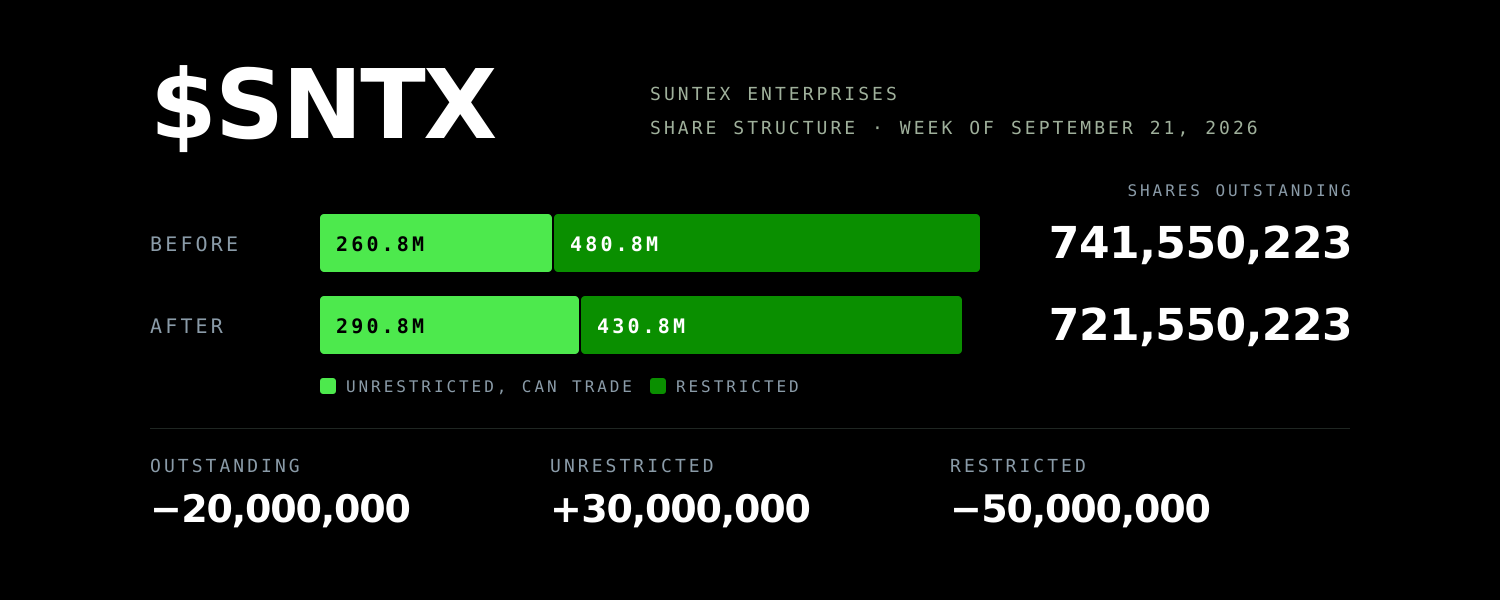
Outstanding: 741,550,223 → 771,550,223 (+30,000,000, +4.05%)
Authorized: 1,000,000,000 (unchanged)
Unrestricted: 260,773,750 → 290,773,750 (+30,000,000, +11.50%)
Restricted: 480,776,473 (unchanged)

Reading date 2026-09-21, source: transfer agent feed.
$SNTX Suntex Enterprises, Inc. share structure update

Reduction detected: outstanding shares decreased (buyback/retirement).
All of the reduction is in restricted stock.

Outstanding: 771,550,223 → 721,550,223 (-50,000,000, -6.48%)
Authorized: 1,000,000,000 (unchanged)
Unrestricted: 290,773,750 (unchanged)
Restricted: 480,776,473 → 430,776,473 (-50,000,000, -10.40%)

Reading date 2026-09-23, source: transfer agent feed.
Read the outstanding lines alone and the week was a win: 20,000,000 fewer shares. Read the buckets and it was two different events. Thirty million new shares went into the unrestricted bucket on Monday. Fifty million restricted shares, two certificates of 25,000,000 each marked Rule 144 on the transfer agent's record, were retired on Tuesday and showed in the count on Wednesday. The total fell 2.7% over the week. The part that can trade rose 11.5%. The company said the new shares were tied to buying residential land in Texas, so that cash could stay with its construction contracts. Whether that trade was a good one is a separate question from what the share count did, and the posts only answer the second.
07Four checks for any dilution
When a post says dilution was detected on a name you follow, these four questions take a couple of minutes and answer most of what matters.
- What did it pay for? Find the company's own explanation and test it against the business. Stock issued to buy an asset while cash funds operations is a different thing from stock issued to cover payroll.
- Which bucket moved? Read the verdict line and the unrestricted line. Only unrestricted stock can reach the market now.
- How heavy is it? Divide the new unrestricted shares by the stock's normal daily volume. On SNTX, 30,000,000 new shares against the prior week's average of 721,928 a session is about 42 sessions of normal trading.
- What offsets it, and has it happened yet? A buyback, a cut to authorized shares or a retirement can net against the new stock. A promised offset and a completed one are different things; the next update post shows which.
08What it does not mean
- It is not a verdict on the company. "Dilution detected" describes the share count, not the business. A company paying for growth in stock and a company selling stock to stay open both trip the same line.
- Unrestricted does not mean sold. New unrestricted shares can sit with the holder, or at the transfer agent, and never trade. The post shows what can be sold, not what was.
- A reduction is not always a buyback. The reduction line covers buybacks and retirements alike, and a retirement of restricted stock leaves this week's tradable supply exactly where it was.
- The feed can lag. Transfer agent figures reach OTC Markets on their own schedule, sometimes days after a company announces a change. The reading date on each post is the date of the figures, not the date of the event.
- It is not advice. Nothing in a post, or on this page, is a recommendation, and nothing here is legal advice about any holder's shares.